Unlock 10% Off Your First Treatment!
Enter your email below and get the coupon code directly in your inbox.
x
Enter your email below and get the coupon code directly in your inbox.
Need help booking an appointment? Call or text us at 437-826-1959 or email us at patientcare@wellnesshaus.com

Dr. Melissa Hershberg, MD CCFP
May 28, 2026
By Dr. Melissa Hershberg, MD CCFP, Medical Director, Wellness Haus · Best-selling author on medical weight loss Medically reviewed: [28 May, 2026] Last updated: [28 May, 2026]
7 min read
Most people walk into a weight loss conversation already convinced of one number: what the scale says. I understand it. The scale is simple, it’s immediate, and it feels like the answer. But after two decades of practicing medical weight loss, I can tell you with complete certainty: the scale is the worst single number to navigate this work with.
Body composition treatment is the better number. Or, more accurately, the better set of numbers. It tells you what you’re actually losing — fat or muscle — and what’s still ahead of you. It tells you whether your GLP-1 medication is doing what it’s supposed to do, or whether something needs to change. It tells you when your treatment is working in the way that matters and when it only looks like it’s working.
If you’re considering a GLP-1 medication — or already on one — this guide explains what body composition treatment actually is, why it matters more than scale weight, and what a real, physician-led program in Toronto does about it.
Body composition treatment is the practice of measuring and managing the three categories of mass that make up your body — fat mass, lean muscle mass, and water — and using those measurements to guide medical weight loss decisions. It’s not a single procedure. It’s a discipline.
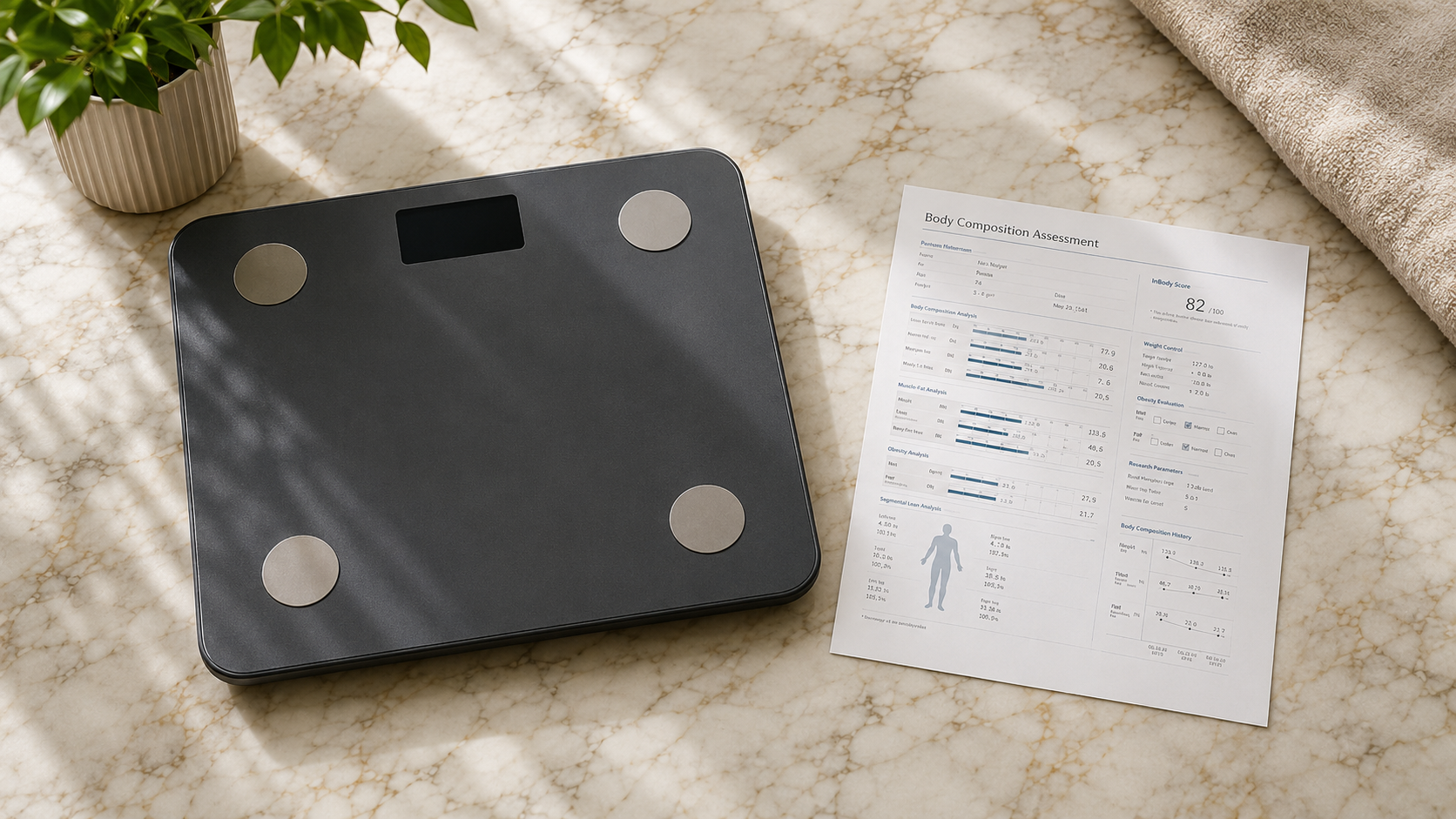
The measurement piece is straightforward. A clinical-grade body composition scan tells you, with reasonable precision, how much of you is fat, how much is lean tissue, and where that fat is distributed. At Wellness Haus, we use
InBody
— a medical-grade bioelectrical impedance device — for every scan.
Some clinics use DEXA (dual-energy X-ray absorptiometry) instead. DEXA is a respected tool, but it exposes the patient to a small dose of ionizing radiation with every measurement. In a weight loss program, we scan patients every 4 to 6 weeks for months at a time — that cumulative radiation exposure isn’t a trade-off I’m willing to ask my patients to make when it isn’t necessary. InBody gives us the same clinically actionable data — body fat percentage, leanmuscle mass, segmental analysis showing where the changes are happening — without any radiation. For longitudinal weight-management care, it’s simply the better tool.
The management piece is where physician judgment lives. The numbers from a scan are only useful if someone with clinical training reads them in context: alongside your bloodwork, your blood pressure, your medications, your goals, and your prior measurements. That’s what turns “data” into a treatment plan.
GLP-1 medications are powerful because they reduce appetite, slow gastric emptying, and reset hunger signals. They work. But the same mechanism that makes them effective also creates areal clinical risk: when patients eat substantially less, the body draws down whatever is most metabolically expensive to maintain. That’s muscle.
A patient who loses 30 pounds on a GLP-1 may have lost 18 pounds of fat and 12 pounds of muscle. That same patient looks at the scale and celebrates. I look at the body composition scan and start a conversation about protein intake, resistance training, and dose adjustment. Same patient. Different number.
“The patient looks at the scale and celebrates. I look at the body composition scan and start a conversation about protein, training, and dose. Same patient. Different number.”
— Dr. Melissa Hershberg, MD
Muscle is not a vanity concern. Muscle is metabolic infrastructure — it determines your resting metabolic rate, your insulin sensitivity, your bone density, and your long-term ability to keep weight off after you finish a course of medication. Losing it is easy. Rebuilding it after a GLP-1course is harder than most people realize.
This is the reason body composition treatment exists as a discipline. The scale cannot tell you what kind of weight you’re losing. A body composition scan can. And a physician-led program treats the scan as the primary signal, not the scale.
Body composition is one signal inside a broader medical weight loss program. At Wellness Haus, every patient on a GLP-1 medication receives the following measurements as a standard of care:
These measurements happen at intake, every 4 to 6 weeks during the dose-titration phase, and at each treatment milestone (typically 3 months, 6 months, and 12 months).
Here’s how a real consultation looks when body composition data is part of the conversation.
A patient comes in at the 12-week mark on a GLP-1. They’ve lost 22 pounds. They feel great. They want to celebrate. Their body composition scan shows that 14 of those 22 pounds are fat— and 8 are lean muscle. That’s a higher-than-acceptable ratio of muscle loss.
Without the scan, this patient continues on the same protocol and finishes their treatment having lost a significant portion of their metabolic infrastructure. With the scan, we have a series of options: adjust their dose downward, increase their protein target to 1.2 to 1.6 grams per kilogram of body weight, prescribe a resistance training protocol with a referral to a physiotherapist, and rescan in 6 weeks.
That’s the difference body composition treatment makes. It isn’t a diagnostic novelty. It’s the foundation of clinical decision-making.
“Body composition isn’t a diagnostic novelty. It’s the foundation of clinical decision-making in areal GLP-1 program.”
— Dr. Melissa Hershberg, MD
If you are searching for body composition treatment in Toronto, the practical question is not which device is best — multiple clinical-grade tools (InBody, DEXA, and certain other bioelectrical impedance devices) produce results accurate enough for treatment decisions. Thepractical question is who is reading the scan.
A body composition scan in a fitness studio or a standalone scan clinic gives you a number. A body composition scan inside a physician-led medical weight loss program gives you a treatment plan.
At Wellness Haus, we use InBody — deliberately. It delivers the data we need without ionizing radiation, which matters when the same patient is scanned every few weeks throughout a treatment program. It’s a small clinical decision that compounds over a 12-month course of care.
When evaluating a provider, ask:
At Wellness Haus, the answer to each of those questions is yes — and that’s the standard you should expect from any serious medical weight loss program.
A body composition scan is the measurement — a single test that tells you your body fat percentage, lean muscle mass, and visceral fat. Body composition treatment is the broader medical practice of using that data, alongside bloodwork, blood pressure, and clinical judgment, to guide a weight loss program over time. One is the tool. The other is what you do with it.
Body composition scans are not generally covered by OHIP as a standalone procedure. At Wellness Haus, body composition assessment is part of our medical weight loss program. We recommend booking a free consult to understand which components of your care are covered through your existing benefits and which are out-of-pocket.
At Wellness Haus, we typically scan at intake, every 4 to 6 weeks during the dose-titration phase, and at each treatment milestone — 3 months, 6 months, and 12 months. The cadence is adjusted based on what the data shows; if muscle loss is happening faster than expected, we scan more frequently.
“Ozempic face” is the informal term for facial volume loss that some patients experience during rapid GLP-1 weight loss. It happens because rapid fat loss is not selective — patients lose fat from their face along with the rest of their body. Body composition treatment helps us anticipate it, slow it where possible, and connect patients into facial volume management options (such as Sculptra, PRP, and threads) at the right time in their journey.
Yes. Body composition treatment is valuable whether or not you are on a weight-loss medication. It is also the foundation of our metabolic health assessments, our membership programs, and our preventive care offerings. A free consult is the easiest way to determine which path is the right fit for you.
Muscle is metabolic infrastructure. It determines your resting metabolic rate (how many calories you burn at rest), your insulin sensitivity, your bone density, and your long-term ability tomaintain a healthy weight after finishing a course of medication. A weight loss program that doesn’t protect muscle mass is not a complete weight loss program.
Both are clinical-grade body composition tools. We chose In Body deliberately. It delivers the same actionable data — body fat percentage, lean muscle mass, segmental analysis — without any ionizing radiation exposure. In a weight loss program where the same patient is scanned every 4to 6 weeks for months at a time, avoiding cumulative radiation matters. For this use case, InBody is the better tool. We don’t ask patients to accept a trade-off that isn’t necessary.
A free consult with the Wellness Haus medical team. We’ll discuss your goals, your medical history, and whether a physician-led GLP-1 program — with body composition treatment built in— is the right next step.
Physician-led · Legit Script Certified · Toronto
Medical Director, Wellness Haus · Best-selling author
Dr. Hershberg has spent her career at the intersection of medicine and weight loss. She leads the physician-led GLP-1 program at Wellness Haus in Toronto, where every patient receives comprehensive monitoring, body composition treatment, plateau management, and long-term care.
Read more about Dr. Hershberg →
This article is for informational purposes only and does not constitute medical advice. Alwaysconsult your physician before starting any weight loss medication or program. Individual resultsvary. Wellness Haus is LegitScript-certified for healthcare merchants.
Subscribe to our newsletter for the latest news, exclusive offers, and expert insights delivered directly to your inbox.